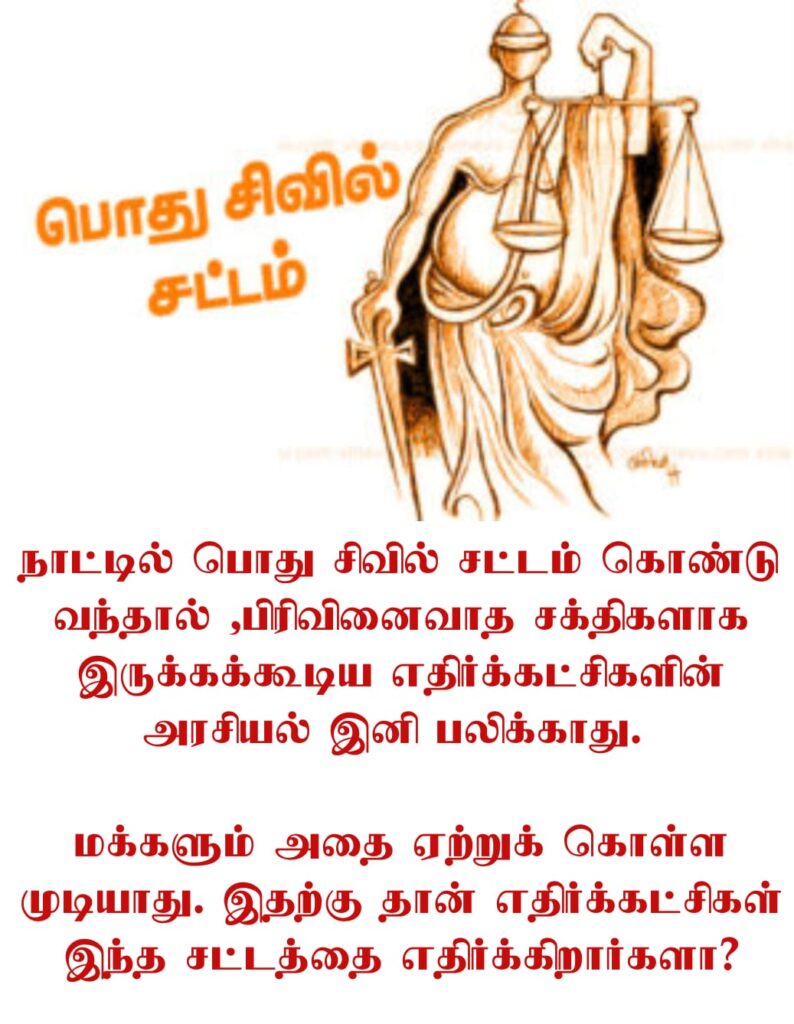
If it is a civil law that provides equal justice to all religions, it is wrong for political opposition parties to oppose it.
Amit Shah has said that the Common Civil Code will be passed before the 2029 Lok Sabha elections.
Further, Home Minister Amit Shah has announced that this law will be brought in 21 states, including those ruled by the BJP and those ruled by their coalition government.
But this law is opposed by Congress, DMK, Liberation Tigers of Tamil Eelam, Communists, etc. Apart from this, men belonging to the Muslim religious organization are more likely to oppose it.
Moreover, women welcome this. The General Civil Code is not a religious law. Then why? Are these opposition parties misleading the people by distorting it as a religious law?

Furthermore, this civil law was enacted during the Congress regime, but due to the change of government at that time, Congress was unable to bring this law.
It is not a newly enacted law, it is. It is a common law for everyone. It is a law that creates equality in all aspects of human life, including rights, property, sexuality, family, and relationships.
However, where is the religion in this? You can do your worship in your religion. You can worship your God. Then why are they opposing this civil law?
When we bring the same standard of individual morality to everyone, the criminals who may be in political parties are afraid. This is a major fear for them.

Also, women of all religions will be treated equally under the same law. This gives Muslims great fear. But Muslim women welcome this.
Because more than any other religion, women are enslaved in Islam. Among them, 99 percent of men are not even a little bit against giving women freedom.
I think they know the explanation for that. Also, when a few auto drivers come to me in their autos, they only express their opposition to it when they talk to me.

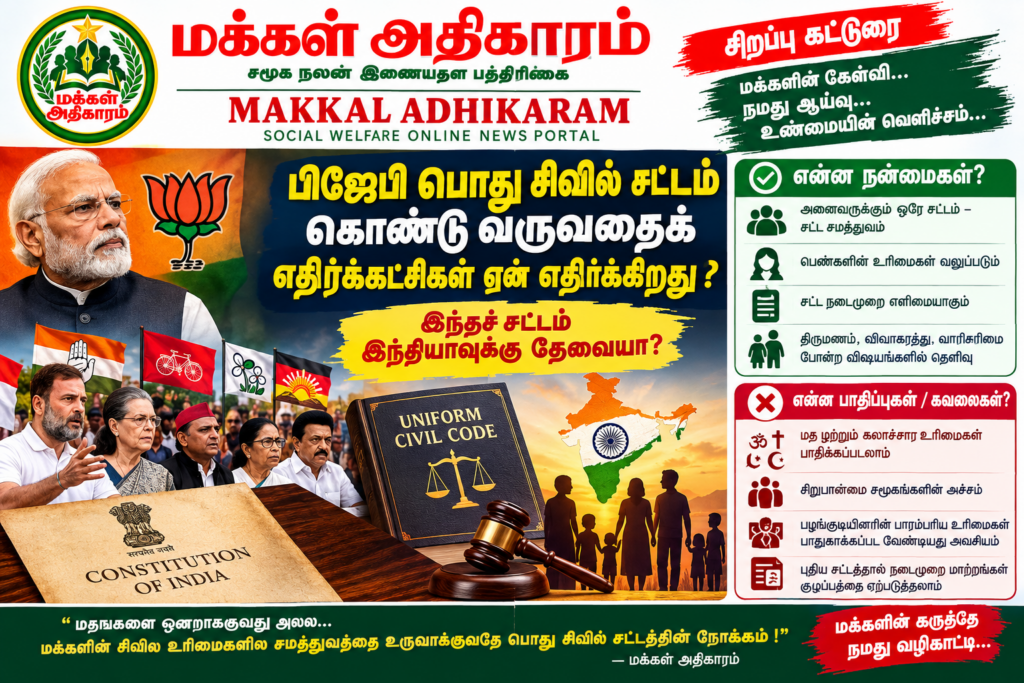
Also, does India need this common civil code?Religion may be different; but should the law be the same in civil rights?The debate on a Uniform Civil Code (UCC) in India has been going on for a long time.
Furthermore, its basic objective is to create a common law for all, instead of religiously based special laws, in personal civil matters such as marriage, divorce, inheritance, adoption, and maintenance.
Furthermore, Article 44 of the Indian Constitution states that the central government is trying to establish a common civil code for citizens across India. However, the opposition parties are opposing it.
Furthermore, this law does not pose any danger to the public. Besides, what are the benefits of bringing in a general civil law?Everyone is equal before the law! What’s wrong with every Indian living in India living under the same law?
Furthermore, legal equality is strengthened if all citizens living in the same country have the same law in civil matters such as marriage, divorce, and inheritance. In addition,Protection of women’s rights,The UCC could provide an opportunity to create laws that ensure equal rights for women in marriage, divorce, maintenance, and property inheritance.
Furthermore, since the legal process is simplified, it is a unified law for many religions.This will make legal procedures easier for the public and in the courts.
The general civil law is a check for forced conversions.
Furthermore, the rights of citizens beyond religion are emphasized through this law. Besides, itThe UCC could reinforce the idea that the basis for a person’s civil rights should be their Indian citizenship, not their religion.
But, some people also have some problems. ThatReligious and cultural rights,Different societies have unique traditions in matters of marriage, family, inheritance, etc. If they are completely ignored, resistance can arise.

Furthermore, the fears of minority communities:The idea should not be created that the practices of the majority community are being imposed on other communities in the name of common civil law. In addition,Traditional rights of tribal people,Many tribal communities in India have unique family and property practices. Provisions to protect them are essential.
Changes due to the new law!There needs to be a clear procedure on how to incorporate existing marriages, property rights, wills, and court cases into the new law!
Moreover, the main question is what kind of civil law do the people of the country need?Imposing the law of one religion on other religions in the name of general civil law is not the right approach.
Likewise, it is unacceptable for the basic civil rights of women and children to be violated on the grounds of religious differences.What is the right approach?

Religious freedom must be protected. Cultural rights must be protected.Women should be given equal rights.The welfare of children must be prioritized.There should be justice in property and inheritance.All citizens should be equal before the law. If a law is formulated on these principles after extensive consultation with all communities, it becomes important for social cohesion and legal equality.The concept of people power.
Religion may be different, worship may be different, culture may be different. But, the general civil law emphasizes that the law should be fair and equal in the basic civil rights of a citizen. Furthermore,
The General Civil Code is not a law that unites religions, but a law that creates equality in the civil rights of citizens.In the interest of the people! As the voice of the people…! And always…… MAKKAL ADHIKARAM .